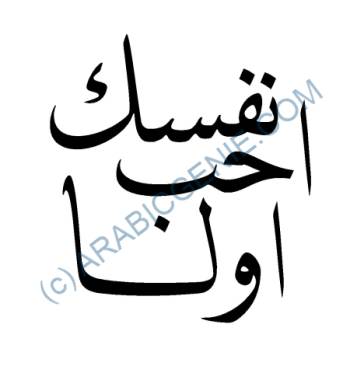
Arabic calligraphy of the proverb “inner wealth is better than other (types) of wealth”:
غنى النفس أفضل من غنى المال
ghinaa an-nafs afDal min ghinaa al-maal

Arabic Proverb: Inner Wealth Is Better Than Other Wealth
Learning Arabic The Magic Way, Arabic Tattoos
Arabic calligraphy of the proverb “inner wealth is better than other (types) of wealth”:
غنى النفس أفضل من غنى المال
ghinaa an-nafs afDal min ghinaa al-maal

Arabic Proverb: Inner Wealth Is Better Than Other Wealth
Posted in Arabic Calligraphy.
– August 25, 2010
I’ve been receiving a lot of requests from readers of this blog and my book The Magic Key To The Arabic Alphabet to create an application that helps them with the pronunciation of the Arabic letters.
Well, after some trial and error I am proud to announce that the Arabic letters application is now online. Please head over to the website and try it out as soon as you can. I am sure that this will help all Arabic learners to get a good grasp of the Arabic letters and their sounds.
Posted in Learning Arabic.
– August 21, 2010
Arabische Tattoos sind definitiv im Trend in der Welt der Reichen und Berühmten. Und ich meine hier nicht temporäre Tattoos, wie z.B. Henna. Das überrascht vielleicht, weil man kaum irgendwelche Tattoos in der arabischen Welt sieht. Aber im Westen sind Tätowierungen nichts anrüchiges mehr. Heutzutage sagt ein Tattoo nichts mehr über den sozialen Status der tätowierten Person aus.
In letzter Zeit haben sich Schauspielerinnen wie Angelina Jolie, Fußballspieler wie Zlatan Ibrahimović und Sänger wie Rihanna arabische Wörter und Sätze auf ihre Körper tätowieren lassen. Aber wissen sie auch wirklich, was genau die Wörter bedeuten, die sie auf ihrer Haut verewigt haben? Schauen wir doch mal genauer auf die Tattoos und ihre Bedeutungen:
Als erstes an der Reihe ist Angelina Jolie, die, wie es scheint, schon jeden Zentimeter ihres Körpers mit Tattoos überdeckt hat. Bei ihrem letzten Besuch im Tätowierstudio hat sie dieses arabische Tattoo gekriegt:

Angelina Jolies arabisches Tattoo
Bei näherem Betrachten können wir das Arabische Wort العزيمة (al-‘azeema) auf ihrem rechten Unterarm erkennen. Das heißt soviel wie „die Entschlossenheit“ oder „der feste Wille“. Ich glaube Angelina ist eine Frau, die weiß, was sie will. Also scheint das Tattoo recht zutreffend. Allerdings, kann dieses arabische Wort auch „die Beschwörung“ oder „der Zauberspruch“ heißen.
Der Schrifttyp für das Tattoo ist relativ einfach gehalten, aber zumindest hat Angelina (oder einer ihrer Mitarbeiter) sich darum gekümmert, dass das Wort richtig geschrieben ist – keine Fehler hier.
Weiter geht’s mit Zlatan Ibrahimović, dem Profifußballer:

Zlatan Ibrahamovics arabisches Tattoo
Für diejenigen, die gerade anfangen Arabisch zu lernen, ist dieses Tattoo wahrscheinlich schwer zu entziffern. Aber die Lösung ist recht einfach: der Schriftzug ist einfach eine Transliteration seines Nachnamens – auf Arabisch: إبراهيموفيج (ibraaheemoofeedj).
Weil das arabische Alphabet nicht für alle Laute in seinem Nachnamen die richtigen Buchstaben hat, musste der Tätowierer (oder jemand der Arabisch spricht) etwas auswählen, was so nah wie möglich an der Originalaussprache ist. Zum Beispiel gibt es kein “v” im arabischen Alphabet. Hier muss man also ein “f” nehmen.
Vielleicht mag nicht jeder die Ichbezogenheit die Ibrahimovićs Tattoo durchblicken lässt, aber zumindest ist das Tattoo korrekt geschrieben.
Zu guter Letzt, was hat Rihanna sich auf die Hüfte stechen lassen?

Rihannas arabisches Tattoo
Auf Arabisch steht hier الحرية في مسيح (al-horriya fi maseeh) – auf Deutsch “Der Frieden in Christus”. Hmm, anscheinend ist Rihanna also religiös, aber wieso versteckt sie diese Nachricht dann auf Arabisch, anstatt sie auf Englisch einem größeren Publikum zugänglich zu machen? Vielleicht sind ihre religiösen Überzeugungen doch eher privater Natur…
Wie dem auch sei, was man mit Sicherheit sagen kann ist, dass das Tattoo nicht ganz richtig ist. Es hätte الحريةفي المسيح (al-horriya fi al-maseeh) lauten sollen, weil „Christus“ im Arabischen einen Artikel braucht. Vielleicht gibt es ja doch noch Hoffnung, denn genügend Platz sollte zwischen den Wörtern sein um den arabischen Artikel AL einzufügen. Also Rihanna, vielleicht noch ein Besuch im Tattoostudio?
Falls Ihr es den Promis gleichtun wollt und Euch ein arabisches Tattoo stechen lassen wollt, dann solltet Ihr sicherstellen, dass Ihr genau wisst, was die Wörter bedeuten, die Ihr für den Rest Eures Lebens auf Eurem Körper tragen werdet.
Posted in Arabische Tattoos.
– August 13, 2010
Arabic dictionaries are crucial for learners of the Arabic language. Using the right dictionary can save you hours of frustration searching for that elusive Arabic word. I’ll show you some of the best Arabic dictionaries I’ve used – both hardcopies and online.

Arabic Dictionary: al-Mawrid

Arabic Dictionary: Hans Wehr
Generally speaking, al-Mawrid is more up-to-date than the Hans Wehr dictionary, but the latter just as frequently contains words that are not included in al-Mawrid. I’d recommend getting both actually. They are both incredibly useful Arabic dictionaries.
Arabic Dictionary: Thematic Lexicon

Arabic Dictionary: Sakhr
Apart from English it also translates from/to Turkish, French and German. Sometimes there is no entry for a word in Arabic-English, but a match in one of the other languages. So if you know any of the other languages try those too.
Arabic Dictionary: Google Translate
Whichever Arabic dictionary you prefer (or a combination), make sure that you get to know its structure so that you can look up unknown Arabic words fast. If you have the time, it’s a great idea to take a look at related words under the same root. This way maybe one of them will stick in your memory. And remember that nothing can replace a native Arabic speaker who explains the word to you with some examples – not even an Arabic dictionary.
Posted in Learning Arabic.
– July 25, 2010
A few months ago I published an article about the Arabic chat alphabet. If you are new to the concept of the Arabic chat alphabet, please read that article first. Today I want to continue this topic by providing two example sentences written in Arabic English and showing how they can be converted into more readily understandable Arabic script.
Note that the following sentences have been caught “in the wild” and they do not all conform to grammatical and orthographical standards.
Example: a conversation between friends
A: wlah emta 5atbti? wlah ma 7d 5abrni 2lf mabruk ya 7lwe!
B: katrin 7bebty alah ebarek fiki 3orsi fi 21-5 anshlh
Now for the “translation” or transliteration into Arabic script:
A: ولله امت خطبت؟ ولله ما احد خبرني. ألف مبروك يا حلوة
A: By god when did you get engaged? No one tolde me. Congratulations honey!B: كترين حبيبتي الله يبارك فيك. عرسي في 5 21 إن شاء الله
B: Katrin darling, thank you for your wishes. My wedding is on the 21st of May God willing.
As you can see it’s really not that difficult to understand the Arabic chat alphabet once you get the hang of the numbers representing certain letters. Of course, often it might take you some time to decode the message if it’s written in a dicalect you are not familiar with.
Posted in Arabic Culture, Learning Arabic.
– July 13, 2010
Here is the Arabic translation of the famous quote from the Bible “The truth shall/will set you free” (John 8:32):
الحق يحرركم
Pronunciation: al-Haqqu yuHarrirukum
In picture format:

With all the tashkeel and harakaat:

Of course, if you are looking to get this phrase as a tattoo, then you should check out my custom tattoo design service.
Posted in Arabic tattoos, Translation.
– July 2, 2010
When you learn one romance language like Spanish, it becomes much easier to learn a related language such as Italian. The same is true for Arabic and Persian (Farsi), even though they are not related linguistically – i.e. they don’t have a common origin. The reason why it is much easier for an Arabic speaker to pick up Persian than say for an English speaker is that the Persian language has been enriched over the centuries with a vast number of Arabic loanwords. So much so in fact that I would estimate that 40% of all words used in Persian are derived from Arabic.
As you read this article you’ll discover exactly how you can use your knowledge of Arabic to pick up Persian extremely fast.
Let’s look at a brief paragraph taken from an article on the BBC’s Persian website. Try to identify the words you already know from Arabic and guess the general meaning of the text.
حامد کرزی رئیس جمهوری افغانستان فردا برای یک سفر پنج روزه به آمریکا می رود. مقامهای افغان می گویند که این سفر اهمیت زیادی برای آینده روابط دو کشور و امنیت منطقه دارد. ده وزیر افغان حامد کرزی را در سفر به آمریکا همراهی می کنند. مبارزه مشترک با تروریسم از جمله مسائل مهم مطرح در این سفر خواهد بود
Here’s the same Persian text again, this time with some help:

In the extract I have indicated names of countries and persons in green, words of Western origin in turquoise and words that Arabic speakers will recognize in yellow. Of the 60 words, 27 are already familiar to someone with knowledge of Arabic. Of course, the remaining 23 words make up a huge part of the text and without knowing their meaning it is difficult to gain a complete understanding. Nevertheless, the yellow, green and turquoise words alone should be enough to get the gist of what’s going on.
Hamid Karzai, president, republic, Afghanistan, journey, America
position, Afghan, journey, importance, relations, and, safety, region
minister, Afghan, Hamid Karzai, journey, America
duel, shared, terrorism, sum, questions, important, discussed (think: maTrooH)
As can be seen from the example of maTraH, words of Arabic origin need not mean exactly the same in Persian. However, it is always a good idea to look back at the roots and think of possible alternative usages. For instance, maTraH clearly derives from TaRaHa and has as one of its root meanings “to bring up (an issue) for discussion”.
The words of non-Arabic origin in the extract are in fact relatively simple:
| Persian | pronunciation | meaning |
| فردا | fardâ | tomorrow |
| برای | barâye | for |
| یک | yek | one |
| پنج | pantch | five |
| روزه | rooze | day |
| به | be | to |
| می رود | mi ravad | (he)goes |
| می گویند | mi guyand | (they)say |
| که | ke | that |
| این | een | this |
| زیادی | ziyâdi | very |
| آینده | âyande | future |
| دو | do | two |
| کشور | keshvar | country |
| دارد | dârad | (it)has |
| ده | da | ten |
| را | ra | (grammatical particle) |
| این | een | this |
| در | dar | in |
| همراهی | hamrâhi | accompanying |
| می کنند | mi konand | (they)make |
| با | bâ | with |
| از | az | from |
| خواهد بود | khâhad bood | (it)will be |
With this help you should be able to understand almost everything. Of course, some of the finer grammatical points will not be immediately clear, but this does not impact the meaning too much:
“The president of the Afghan republic, Hamid Karzai, is going on a five-day trip to America. Afghan sources say that this trip has great importance for the future of the two countries’ relations and for regional security. Ten Afghan ministers accompany Hamid Karzai on the trip. The joint fight against terrorism will be one of a number of important issues that will be raised in this trip.”
So how can you take advantage of your Arabic vocabulary when learning Persian? The first step is to engage with short Persian texts that deal with topics you are at least somewhat familiar with. Highlight the words you recognize and try to get the gist of the text. After a while you might notice that a few Persian words seem to appear very frequently (e.g. yek – “one”). Look these words up in a dictionary and see if you remember them later on.
In a second step you should get hold of a few Persian language courses to learn the basic words that are in common usage and to learn a few basic grammar rules (e.g. verbs generally go at the end of a sentence, basic conjugations etc.). Then you will be equipped to have a very good reading knowledge of Persian.
It is then up to you to decide whether you want to learn how to speak in Persian, to understand spoken Persian and to write Persian. Whatever you decide to do you will have a huge advantage.
Posted in Learning Arabic, Persian.
– June 27, 2010
My new book Arabic Swear Words And Insults is now availalbe for direct download from my webpage. It contains all the rudeness, curses, insults and swear words that you were never taught at school …and then some! Please take a look and let me know if you have any questions about the book.
Posted in Arabic Culture, Learning Arabic, books.
– June 20, 2010
In a comment on one of my blog posts on Arabic tattoos a reader suggested that
جمال الروح djamaal ar-rooH (beauty of the soul)
might be a good phrase for a tattoo. I like this phrase and have created a calligraphic design of it below:

If you are interested in getting a calligraphic tattoo design, please contact me for a quote. For simpler designs please take a look at this page here.
Posted in Arabic Calligraphy, Arabic tattoos.
– May 19, 2010
Firdaus sent me the following picture with the request to identify the Arabic writing in this tattoo:

The writing is an artistic calligraphic rendering of on top:
حب (Hubb)
and on bottom:
سلام (salaam)
which mean “love” and “peace” respectively. Confusingly, the dot that belongs to the letter baa’ is placed under the meem for what I guess are aesthetic reasons.
Posted in Arabic Calligraphy, Arabic tattoos.
– May 14, 2010
Recent Comments